1st President of Malawi
Hastings Kamuzu Banda
Hastings Kamuzu Banda, Malawi's first President (1966–1994): life, career, one-party rule and the public debt during his presidency.
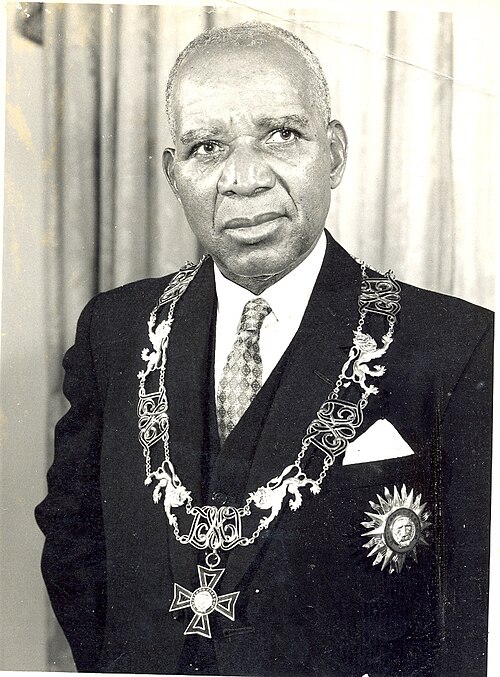
Biography
Hastings Kamuzu Banda was the 1st President from 6 July 1966 to 21 May 1994, for the Malawi Congress Party. The office of Vice President did not exist during this presidency.1
He was born in Kasungu. He studied at University of Edinburgh, Central State University, University of Chicago and Meharry Medical College. Before the presidency he worked as a diplomat and a physician. He also served as Prime Minister of Malawi (1964–1966).
He lost the 1994 election with 33.44% of the vote to Bakili Muluzi's 47.15%.2
During the presidency, public debt went from 17.5% of GDP (end-1970) to 41.2% (end-1993).3
He died on 25 November 1997 in Johannesburg.
Public debt during the presidency
- Debt to GDP when taking office
- 17.5% (end-1970)
- When leaving office
- 41.2% (end-1993)
- Change
- +23.7 points of GDP
- In US dollars
- n/a → US$1.24 billion
Measured the same way for every president: debt as a share of GDP at the year-end nearest each handover, or the Ministry of Finance's figure for the handover itself where one exists. Compare every president · Live national debt clock
More about Hastings Kamuzu Banda
Hastings Kamuzu Banda led Malawi from independence until 1994, first as Prime Minister and then as the country’s first President.
Born in Kasungu District, he left Nyasaland as a young man and studied in the United States, qualifying as a doctor at Meharry Medical College, and again in Edinburgh. He practised medicine in Britain and the Gold Coast (now Ghana) for many years.
He returned home in 1958 at the invitation of the independence movement and became leader of what became the Malawi Congress Party. Jailed by the colonial authorities in 1959, he was released in 1960 and led the country to independence on 6 July 1964 as Prime Minister. When Malawi became a republic on 6 July 1966 he became its first President.
Malawi became a one-party state under the MCP, and in 1971 Parliament made him President for Life. His government is remembered for building roads, the University of Malawi and the move of the capital to Lilongwe, and for the repression of opponents.
Church leaders, donors and a growing democracy movement pressed for change in the early 1990s. A referendum in 1993 restored multiparty politics, and Banda lost the general election of May 1994 to Bakili Muluzi. He died in South Africa in 1997.
References
- Office of the President and Cabinet, Malawi
- Malawi Electoral Commission: presidential election results
- Ministry of Finance, Malawi: public debt reports (with the IMF Global Debt Database for years before them)
Written by Ask Malawi from the public records cited above; no text is copied from other sites. Updated 10 October 2026. Spotted a mistake? Tell us.