2nd President of Malawi
Bakili Muluzi
Bakili Muluzi, Malawi's second President (1994–2004) and the first elected in a multiparty election: life, career and the public debt during his presidency.
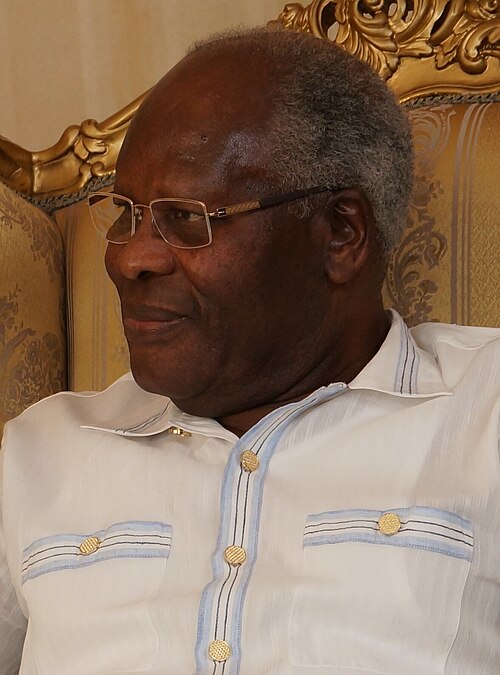
Biography
Bakili Muluzi was the 2nd President from 21 May 1994 to 24 May 2004, for the United Democratic Front. The Vice Presidents were Justin Malewezi (1994–2004) and Chakufwa Chihana, Second Vice President (1994–1996, 2003–2004).1
He was born on 17 March 1943 in Machinga District. He studied at Boston College. Before the presidency he worked as a businessperson.
He won the 1994 election with 47.15% of the vote and won the 1999 election with 52.34% of the vote.2
During the presidency, public debt went from 41.2% of GDP (end-1993) to 84.7% (end-2003).3
Public debt during the presidency
- Debt to GDP when taking office
- 41.2% (end-1993)
- When leaving office
- 84.7% (end-2003)
- Change
- +43.5 points of GDP
- In US dollars
- US$1.24 billion → US$3.96 billion
Measured the same way for every president: debt as a share of GDP at the year-end nearest each handover, or the Ministry of Finance's figure for the handover itself where one exists. Compare every president · Live national debt clock
More about Bakili Muluzi
Bakili Muluzi was Malawi’s first democratically elected President, serving two five-year terms from 1994 to 2004.
Born in Machinga District, he worked in business and served in the Malawi Congress Party government in the 1970s and 1980s, including as a minister and as the party’s secretary-general, before leaving politics.
In 1992 he helped found the United Democratic Front, one of the movements that campaigned for an end to one-party rule. He won the May 1994 election, Malawi’s first multiparty presidential election, and was re-elected in 1999.
His government introduced free primary education in 1994, expanded press freedom and opened the economy. An attempt to change the Constitution to allow him a third term was defeated in 2002 and 2003, and he handed over to his chosen successor, Bingu wa Mutharika, in 2004.
Public debt rose sharply in his decade in office, helped by the fall of the kwacha after it was floated in 1994, and was later cut through the debt relief that Malawi completed in 2006.
References
- Office of the President and Cabinet, Malawi
- Malawi Electoral Commission: presidential election results
- Ministry of Finance, Malawi: public debt reports (with the IMF Global Debt Database for years before them)
Written by Ask Malawi from the public records cited above; no text is copied from other sites. Updated 10 October 2026. Spotted a mistake? Tell us.